Beyond

I hope I never lose my sense of wonder. If that makes me naive, then so be it.

Thursday, 15 March 2012

daring kitchen, march

This month's challenge was a perfect mid-winter one for me: braising.

"The March, 2012 Daring Cooks’ Challenge was hosted by Carol, a.k.a Poisonive – and she challenged us all to learn the art of Braising! Carol focused on Michael Ruhlman’s technique and shared with us some of his expertise from his book “Ruhlman’s Twenty”.

Braising is, basically, a combination of dry and wet cooking. Searing the meat ('dry' cooking - just done in some oil) gets that lovely chemistry going to carmelize, add texture and flavour to the meat and deepen the colour of the dish. Cooking slow in acidic liquid ('wet' cooking) breaks down the meat, resulting in a rich, flavourful, cut-it-with-a-spoon dish. There is a lovely homey, simple,rustic feel about making these, though the taste is complex and satisfying.

I decided to tackle this one early on in the month, and so made a red wine braise of short ribs, using the recipe provided with this month's challenge. The rib roast was cut into sections and these were dredged in flour, then browned in batches in the deep cast-iron pot.

The meat was removed as it browned, then onion, carrot and celery were cooked in the pot (the onion/carrot/celery combo is very like the classic mirepoix used as a basis for stocks in French cooking. I found this interesting and really, mirepoix is just such a fun little word) to caramelize and soften. The meat returned to its cozy pot, and then almost a whole bottle of a California Zinfandel was poured over the lot. Wow, that smelled good. It was a nice, fruity wine (how do I know? I did say almost a full bottle, didn't I?). Garlic, bay leaves, peppercorns, brown sugar, and salt all joined in before the heavy lid was put on ajar and the pot hefted into the warm oven.

Then I had four hours off.

There is something of a warm fuzzy in having dinner mostly done at 1:30pm.

After time of working on projects with the kids, doing some music stuff, and just generally living and enjoying the smell wafting from the kitchen, it was time to get back at it. The meat all tender and delicious, was removed from the pot and the braising liquid strained, then the fat skimmed off the top.


Mushrooms were sliced and sauteed in a dry skillet, pressing on them with a spatula (this was a new technique - and I loved it! Nice texture). New carrots and celery were sauteed in butter until soft, then everything - meat, strained liquid, and sauteed mushrooms - was added back into the pot. Sounds like a lot of back and forth, which it was, but at the end there were only two cooking pots to clean!

Finished and served on mashed potatoes 
To finish off, I made a gremolata. I had never heard of a gremolata. And gremolata is another of those words like mirepoix that is just fun to say. It looked like a nice little garnish. Turns out, a gremolata is a little shot of fresh amazing that you put on top of something like this. Chopped garlic, lemon zest, and parsley. Sounds like a small thing not worth the time, right? NO. Worth it all the way.

The braise's flavour was deep, rich. Layers of taste that had a mellow feeling to them - and then the gremolata gave the palate that pop of fresh, bright flavour that set it off perfectly. A wonderful combination, served on a bed of whipped potatoes. The different techniques and parts of the dish added texture and taste that all came together in one united whole. Delicious!

We finished that meal with another bit of a first for me, as I flambéed for the first time with Crepes Suzette. Yum! All in all, a fun afternoon and evening in the kitchen.

Thursday, 23 February 2012

saucy: a culinary project

I've been learning so many things from the Daring Kitchen challenges. The more I've learned about food, the more I've realized I don't know. While it's a typical thing for me to realize that as I learn about anything, in the case of food it's gotten me very curious. So a while back, I decided to take on a little project of my own. Nothing nearly so daunting as a Julie/Julia Project, but something more methodical and directed than many of my cooking ventures.

I want to learn the French sauces, learn the technique of each and try a few variations on each.

"Sauces are the splendor and the glory of French cooking" - Julia Child

Sauces make such change in a meal. The meat or vegetable is there, cooked. Along comes a sauce to add layers of flavour, ideally accenting but not drowning or overpowering the dish. They may be thickened by addition or reduction, the flavours of herbs, wine, and stock melding to make something more than the mere sum of the parts. I've made several over the years, but have never made a progression through the different types.

"He drank poison? Well. Erm. This is awkward"
A brief history: they've been used for millenia, literally. Some of the earliest ones were of the fermented-fish variety called garum (and before you think 'ewwww', think Worcestershire, a sauce that owes its beginning to those) and very complex. The champions of great cuisine back in the Greek and Roman days occasionally seemed to prefer ending their lives at elaborately staged feasts where they'd have a massive blowout of a party, then drink poison. Quite a way to go, I guess, but you're really sticking someone else with cleaning up the dishes and that's just not fair to one's guests.

Enter Charlemange, and the feasts of the Middle Ages where quantity, not quality was the thing, and spices were often used to cover the fact that food preservation in those times was not the greatest. Some early versions of a sauce de grané, a thickened sauce that we know better today as gravy, started to appear in the 14th century. Catherine de Medici brought Italian influence to the French court in the 1530s, bringing along innovations such as the fork (yes, really). The mid-1600s brought the first systematic cookbooks and the use of roux in thickening, and by the late 1700s French cooking was becoming more standardized, and the sauces established enough that Antoine Carême classified them into four groups (espagnole, allemande, velouté, and béchamel).

The modern sauce organization comes to us from Auguste Escoffier (1846-1935), known as the 'King of Chefs, and Chef of Kings' (a title he seems to have shared with - or perhaps was the next to inherit from - Carême). He simplified the methods of French food preparation, and his reorganization of the sauce categories is the one most often seen today.

So. I find myself with five mother sauces. Each of these has many, many variants, so I plan to try a couple of each. The five are:
  • Espagnole - roux brun, brown stock, and aromatics
  • Béchamel - roux blanc, milk, and aromatics
  • Velouté - roux blonde, white stock, and aromatics
  • Tomato sauces - 'nuff said.
  • Hollandaise - egg yolk and butter. Some would put mayonnaises and aïoli here, the main difference seeming to be hot versus cold. 

And in the midst of this I'll be figuring out demi-glaces, mirepoix, and other assorted odd terms. Two books are my main resources in this: the aptly-named Sauces, bu Michel Roux, a sweet little book I picked up at the book shop in Carleton Place, and The Sauce Bible: Guide to the Saucier's Craft, by David Larousse, kindly loaned to me by a friend of D's from work. 

I'd say it's like school again, but majoring in Biology really never gave me a chance to eat many of my studies.

Tuesday, 14 February 2012

daring cooks, february

Something so simple, we've all likely had at least one version of it - but so many possibilities! This month's challenge was to make patties, and I got my act together early enough to try a few different versions. 

The Daring Cooks’ February 2012 challenge was hosted by Audax & Lis and they chose to present Patties for their ease of construction, ingredients and deliciousness! We were given several recipes, and learned the different types of binders and cooking methods to produce our own tasty patties!

Take One: Fish Cakes.

I decided to start the month with one of the provided recipes and so made tuna and rice patties. I do like fish cakes, and there is something satisfying about feeding a family of 5 (3 of them teens/preteens) with one can of fish. Perhaps it's my Scottish ancestry coming into play.

The can of tuna was filled out with white rice, chopped spinach, corn kernels, and bread crumbs. Binding (a must in any patties, lest they collapse into a crumbly mess) was provided by eggs, and the flavors were added with hot chili paste, oyster sauce, green onions, and sweet chili sauce. 

I also learned what I started calling The Best Patty Tip Ever: rather than relying on my eyeballing of portion sizes and shapes (and typically failing miserably at any attempts at evenness), I made the patties in a half-cup measuring cup, just like making sand castles in the old days. Pack it in, shake it out, and voilà - a perfect one every time. They were coated with more bread crumbs, and fried in the skillet.

Delicious! Definitely a make again, and good even as leftovers. There weren't many of those, though, as the cakes were quickly snapped up as second helpings.

Take Two: Quinoa Patties

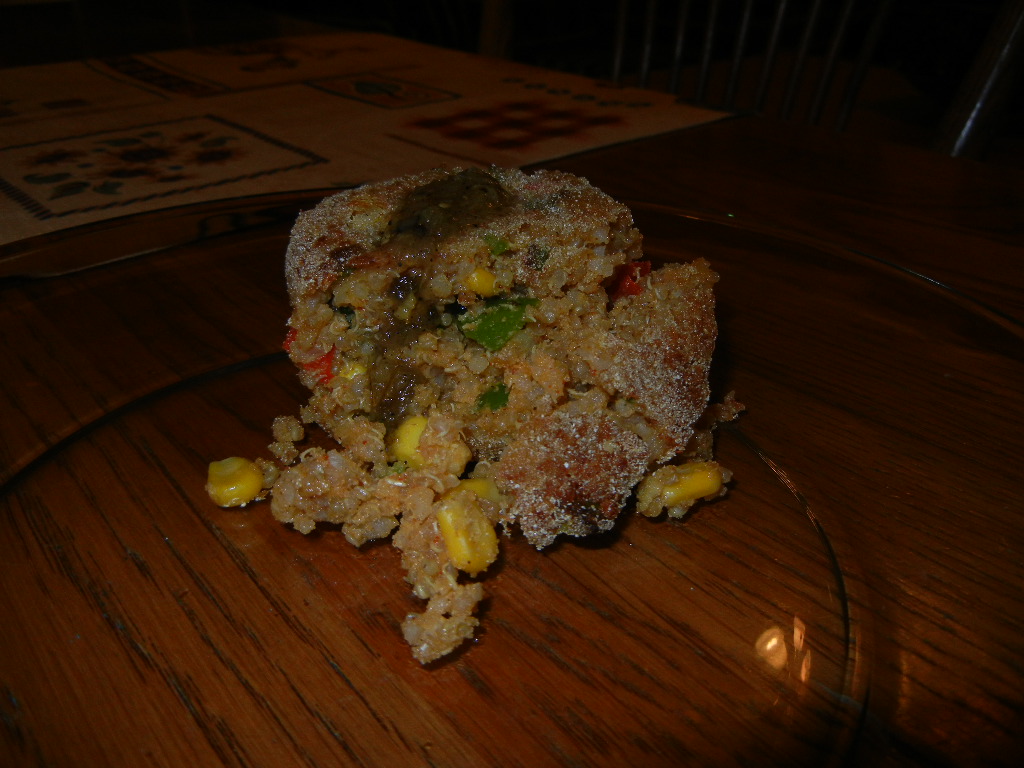
I love cooking with quinoa as a healthy protein source, and figured it would work well in this medium. I decided to make something up as I went along, and came up with a Mexican-style patty that we all loved. Quinoa, corn kernels, cornmeal, and rice, bound again with eggs, color and flavor from red, green and jalapeno peppers, and seasoned with chili powder and cumin. I used the sandcastle technique (thank you for this, Lis and Audax!) again, breaded the patties in cornmeal, and fried 'em up. A little salsa verde on top, and we were set to go.

They were great! The texture was too crumbly to have gone in a bun, but they held together just fine for eating with a fork. We liked the taste, as I madly tried to remember just what I had put in them so I could repeat the new recipe. These, again, had the added appeal of being a very cost-effective way to feed our family. We've had them once since. 

Take Three: MEAT.

Before: they look normal enough, if a little lumpy.
No patty challenge seemed quite right without a burger. But, I've made burgers loads of times. We use the grill most of the time in summer, so they get plenty of opportunities on the menu. I wanted to do something different. I did some searching and found a recipe from Alton Brown called 'Burger of the Gods'. That seemed to bode well, so I tried it last night for supper. And.

Oh. My. Goodness. I will confess to sitting, paused mid-chew, at the first bite.

Sirloin steak and chuck steak were ground up in the food processor. I added a pinch of salt, mixed it up, and formed the patties. Three ingredients; that was all. The meat's own fibers and fat served to bind the patties, and we fried them in the pan. Normally I hate doing hamburgers in the pan; the taste just doesn't compare to a grill. Even done on the frying pan, however, these were absolutely amazing. 

Hellooooo beautiful!
My 15yo daughter sat and raved between (and during sometimes) bites. My hubby the carnivore absolutely loved them. They are an entirely different food from a ground beef burger - there's just no contest. These were obviously not the most frugal of the three, but we will absolutely make them again.  

All three gave variety, will-try-again recipes, and this month gave me a new understanding of the elements of it so I'll be able to improvise more in the future. Thanks for a great challenge!

I'm still thinking about those steak burgers.... yummmm. 


Saturday, 4 February 2012

sad days

We are, for the first time in almost seventeen years, dogless. Is that a word?

Meme, who joined our family just a year ago as a six-year old retiring from a successful career as a show dog and mom to many champions, had a sudden (to us) decline and had to be put down. I wonder, does it get easier when you've had more dogs? I took her to the vet when she became lethargic, and at the vet she started twitching with mini-seizures. A growth on the liver, and apparently the kidneys shutting down gave a poor prognosis. Tearfully, the decision was made. I wasn't alone at the vet; 13-year-old A was there and impressed me with her strength. She was crying so hard but stayed in the room, choosing to be there as the shot was given and Meme fell asleep for the last time.

We brought her home and D, wonderful support that he is (texts of "do you need help to take her to the vet?" "do you need me to come there?" had been flying, and a quick call to make the final decision had his voice helping me), came home from work early to dig a grave. We're getting to have something of a pet cemetery down there now.

It has hit A the hardest; Meme and she had a special connection. Meme liked us, but she loved A. And she was loved right back. She was a great dog, and a funny mix of maternal and tough. She would carry socks to a corner to make a sort of nest, but then she was the dog that killed a skunk before it had a chance to spray.

A few sad days have followed.

And why, yesterday, out of the blue (no anniversary, no birthday date to trigger the thought) did I suddenly hear, replaying in my mind, the phone call from my mom about J's accident? I could hear her voice saying it as clear as if it had been yesterday. Where did that come from? Why that? Why now? I have no idea.


Wednesday, 25 January 2012

unintentionally outside the box

Every now and then I realize that, well, we're weird.

We left suburbia for the country, choosing a small, drafty farmhouse over a large, modern, all-the-amenities home. We started making our own food, including the animal variety, thanks to chickens, ducks, and deer.

The kids were, until this year, all homeschooled. R entered grade 10 this year and while she enjoys it, she has said several times that she's glad of the timing of it, and is glad that this was the year she went to public school and not sooner. She's adjusted well to a more regulated schedule, but it hasn't changed her easygoing nature and positive outlook.

Church to them includes setting up chairs and sound equipment in a gym each week, knowing an XLR mic cable from a patch cable. It means applying their faith through the week, trying to see the world as Jesus sees it, and making choices based on that.

We aren't heavily scheduled. The kids take music lessons, go to youth group, and hang out with their friends. But if we're stuck at home, they don't drive me nuts. Sometimes they will disappear, singly or together, and have virtual, imaginary, or real adventures. Other times we're all together, experimenting in the kitchen on some new food we've decided to try simply because we've never tried it.

They love music and experiment on their own time. They've started a band with a friend, practicing together, using the sound equipment here. M writes songs. A and R write stories. I realized a while ago that growing up in a house where a band meets weekly, and where I write music, this is normal life to them.

And I like our weird normal.